I was very lucky to be able to attend the workshop on `Decolonizing perspectives across disciplines: Data, research and teaching’ that took place at All Souls College at the University of Oxford on 26th February 2026, organised by Prof. Celeste Rodriguez Louro (University of Western Australia) and Prof. Miriam Meyerhoff (All Souls College, Oxford). Even though I have never explicitly contributed to decolonialising research myself, I went along because as a good colonial subject (from Indo-Trinidadian and Gaelic-ancestor Scottish parents respectively) currently inhabiting the halls of ultimate privilege (Oxford), I felt I was due a dose of consciousness-raising and self-examination.
I was not disappointed. Here is a flavour of the stories of different practices and histories that were showcased at the workshop. I have summarized these talks in my own highly idiosyncratic way, based on my own particular hooks and obsessions. I alone am responsible for the errors and omissions that might have resulted from my imperfect uptake. This blog post is long but does not do justice to the complexity of what was offered up by the workshop. The programme for the workshop with names, titles and abstracts can be found here . Check it out and follow up if you are curious about any of the themes.
The workshop kicked off with Dr Surbhi Kesar (Economics, SOAS, University of London) whose contribution from the field of Economics evoked the dark shadow that hangs over every attempt to resuscitate justice and equality in our unequal and unjust world. In many of the cases we discussed in the workshop, the economic forces of global capital steered the choices of both bad actors and disempowered communities alike. In this case, Surbhi was showing us economic data from India which went against the dominant narrative of the field. A dominant narrative in which a normative teleological discourse correlates civilisation, rationality and progress with a capitalistic framing for Value and Growth. Such a narrative has classically ignored and disregarded the violent dispossession and exploitation of indigenous communities that form the basis for European economic growth. Economies not conforming to this idealized trajectory are cast as `behind’ on the developmental path. What Kesar argues is that many more traditional economies are characterized by a kind of dualism where more locally rooted pre-capitalist structures exist side by side with industrial development. There is a kind of continuity manifested in many of the world’s developing economies where the `informal’ economic sphere persists in the same proportion as before, as high economic growth fails to correlate with labour absorption and structural change. In South Asia, about 86 percent of work is in the informal sector and in Africa the percentage is about 81. Still, in the mainstream narrative, the informal sector is framed as a temporary blip on the path to progress. While the expansion of the formal capitalist sector appropriates resources, and undermines informal and subsistence based, local systems, large sections of the workforce actually remain unabsorbed. In India we see a constant regeneration of different kinds of informal modes, and throughout this continuous and disruptive churn and flux, large sectors of the community remain trapped in cycles of poverty, despite high `growth’ rates in some sectors. Kesar’s talk highlighted the ways in which the narrative used to describe the economic situation in India is often hijacked by self-serving storylines from extractive and colonizing actors, and where the true reality (an understanding of which is necessary to effect meaningful change) struggles to emerge.
Whose Story, and What Language?
Bassey Antia (Linguistics, University of Western Cape) continued the theme of `who gets to tell the story’ in his examination of the language and framing found in textbooks. He argues that this is worth doing more than ever because for a student in a colonized environment the textbook is a primary site for engagement with knowledge and affects how we perceive ourselves because of the very basics of how We and the Other are constructed. It turns out that texts betray a colonialist mindset even when the authors consider themselves to be following a more progressive agenda. Antia presented and deconstructed some texts in this genre, asking questions concerning, among other things, how agency and epistemic authority are asserted and assumed, and how ideas are differentially presented as internal or external in the metaphorical archive of knowledge. Some of the examples he presented were quite convincingly shocking. To quote one past Oxford historian “There is no African history, there is only the history of Europeans in Africa. The rest is largely darkness. And darkness is not s subject for history.’’ And lest one should imagine that we can blame orality/oral culture as a contingent reason for why certain storylines get squeezed out of the dominant narrative, we should contrast the colonial situation with the one we find with Ancient Greece, where the authority for characterizing past history comes from the oral culture of the Ancient Greeks themselves. African histories too can be told, but they must be told through African voices, knowledge and oral culture. But to do that, and to put them in writing for the next generations, the textbook writers have to listen.
What language should the subjects of colonialism write their histories in, and what language should they use to explore and interpret the modern spaces they find themselves in? William Frager (Linguistics/International Policy, Oxford) has explored these questions from the point of view of language educational policy in modern day Haiti. As the daughter of a Trinidadian father who has spent his academic life exploring and promoting the creative literary output of the anglophone Caribbean (check out Kenneth Ramchand here ), I am directly and viscerally witness to the negotiations around language that inevitably arise from using language to tell your stories, but when the language you have been given to tell the story is the one originally imposed on your community by the oppressors themselves. Haiti is a special, and heartbreaking case. They achieved independence in 1804, a staggering and unique achievement by a group of African enslaved peoples fighting a revolutionary war against the same aristocratic landholding classes that were overturned in the French revolution itself just a couple of decades prior. According to Wikipedia “Haiti was the first independent nation in Latin America, the first post-colonial independent black-led nation in the world, and the only nation whose independence was gained as part of a successful slave rebellion.” (footnote: one could argue looking at their subsequent history, that Haiti has been punished for that remarkable victory ever since). The country had been called Saint Domingue under the French, but in 1804, on achieving independence, it was named Haiti after the original indigenous Arawak name for the island. Language matters, and what you name things matters. Since independence, French consistently dominated language school exams and textbooks in Haiti. French creole, or Kreyol persisted underground as the actual language of communication, but not mentioned explicitly because I imagine it was thought of as simply being French (albeit a degenerate and broken form of `notre langue’). In 1957 Kreyol is sufficiently a `thing’ for the Haitian constitution to explicitly ban it for use in education. However, in 1979, the law legalizes the creole as both an object and medium of instruction. Despite this, Haiti has not consistently adopted MTE (Mother Tongue Education) across its school system. Side by side with the inevitable resistance from `above’, the initiative has also met resistance from Kreyol speakers themselves, as they see it as a change that would `forever relegate their children to a Kreyol ghetto and deny them access to social advancement.’ Research on MTE shows us that creole-based education would improve students’ learning outcomes and sense of self worth, but this is perceived as being outweighed by the disadvantages such MTE students would have in the subsequent capitalist job market. Frager presented his research on this fraught question based on interviews done over a period of interviews conducted in early 2022 with both Haitian elites and non-elites. It seems that progress in MTE for non-elite groups will end up being determined by the market, and by the status of Kreyol, English and French respectively in the language capital stakes. And as we have seen, capitalist systems have an inexorable and self-consistent logic whereby human dignity, freedom, confidence and joy in your own language and cultural heritage are not very highly valued.
Frager’s presentation also finds echoes in the presentation by Lucia Fraiese (Linguistics, University of Western Australia) who studies the indigenous varieties of English as spoken by First Nations students in a present day boarding school in Western Australia. The administrative systems in this school do not record the original languages of these students, and the staff is predominantly Anglo-European. Boarding schools were historically central to projects of assimilation. Fraiese’s spent some time in the boarding school in informal settings with the students, recording spontaneous conversations. Her study argues that the students in the school use their particular variety of indigenized English to build a joint style as a form of semiotic resistance, a form of identity and rebellion. Language is symbolic capital, and she notes that other students ended up aligning with the indigenized version of English in solidarity.
Is there anybody there to tell the story of Florencia, an 18th century indigenous woman of the Bare people in Rio Negro in from the Portuguese controlled Amazon region ? Joana Neves Teixeira (History, Oxford) digs into an archive inquisitorial case file against. Florencia, which is one of the very few cases against indigenous defendants on record. Florencia’s story has to be discerned through absences. It is a bigamy case, so we know the dates of her marriages and the fact that she has a six-year-old child in 1766. In the account of her trial, her testimony is recorded but is silent on the language she testified in (or whether there was even an interpreter). The illiterate men who testified concerning her life during the trial sign their testimonies with an X, but Florencia is apparently not empowered to do so for her own testimony. Can we trust the court’s record of what she said in her own defense? From the archive one might not even realise that Florencia did not speak Portuguese, except for the fact that when she is released in Lisbon in 1768 she is exonerated by the court there on the grounds that she does not speak Portuguese and therefore `knows no better’. Whereupon she ends up on the streets of Lisbon and we have no more record of her, as she slips away again like a cipher, smothered into silence among the streams of other people’s stories.
Celeste Rodriguez Louro (Linguistics, University of Western Australia) tells us of her work in Australia with users of aboriginal English. There is a similarity here to our Haiti situation, in that the English of the Australian aboriginal communities is a language imposed by the coloniser and where social and political violence was involved in imposing it, a direct consequence of the demise of the native tongues that should be their linguistic heritage. Instead, in the context of brutal economic and political realities, and an English language hegemony in which aboriginal English is often framed merely as broken or inferior English, this living variety struggles to get its story heard or even be recognised as a legitimate linguistic code. Like Haitian Kreyol in the previous case, Aboriginal English is a language that so many speak, and yet so few are willing to speak up for. Celeste collaborates with Dr Glenys Collard to embrace a mode of indigenous storytelling known as yarning, as a way of both gathering sociolinguistic data for analysis but also producing video materials that are useful to the communities themselves. In a way too, Louro’s work is a direct counterpoint to Teixeira’s documentation of the erasure of our indigenous female bigamist (biandrist?) Florencia. In embracing and incorporating yarning as part of her relational practice Louro reinscribes the voices of those who are still too often erased into the scientific, cultural and sociological discourse. We all win when these stories, storytellers and new ways of telling the story become visible.
When the Story Gets Stolen
This blog post is converging on the theme of storytelling— who gets to tell the stories? and using which languages? But sometimes the narrative gets coopted. Let us first take an example from Science. Recently, there has been rapid advance in the scale and detail of ancient human genome studies. Ruaridh MacLeod (Archaeology, Oxford) was there to tell us a bit about this nascent field and how its massive popularity has exacerbated tendencies for self-promotion and ruthlessness within the field. I would never have thought of ancient human genome studies as being anything other than extreme and fascinating nerdiness about the archaeological record going back to the origins of humanity. Turns out it is a field that is ripe for co-opting by bad actors on the far right with a eugenicist agenda. There has been real pushback from other archaeologists, who point out the damaging rhetorics and narrative tropes that they recognise from an older and less enlightened archaeological tradition. MacLeod argues that the new field of ancient genome studies has lent itself to biased interpretation/discourses, falling into the traps of race based science and eugenic science. What we should be doing is asking how scientists can repair their relationship with First Nation peoples as they probe the past; instead, the new data from ancient DNA is now being misused and abused in many different ways. Because I’m comfortably within my bubble, I don’t get exposed to Nazi youths performatively chugging milk in my feed (yes, that’s a Thing. And no, you don’t really want to know.) More seriously, for this blog post, the phenomenon highlights that the data and facts are not neutral. They are embedded in narratives, and who gets to tell those stories matters.
Alpa Shah (Anthropology, Oxford alerts us to the fact that the decolonial narrative itself can be co-opted for crude political ends. The Modi government in India has consistently presented itself as the decolonial force for good, bringing India back to its true (Hindu, nationalist) self. In India, English paradoxically has often been the choice of progressives as a politically neutral language of unity external to local linguistic rivalries and power grabs. The Hindi/Hinduism-toting crudely nationalistic Modi government has imprisoned 16 intellectual activists, based on a flimsy claim of instigating riots, but really because they are all activists against big capital and authoritarianism. Read her book ! The linguist Hany Babu (associate professor of language and linguistics at Delhi University) who is one of the 16 still incarcerated is known to me from many past linguistics conferences and I can vouch for the excellence and deep humanity of his work. His only crime, apparently, has been to consistently advocate for greater protections of marginalised languages, and be an anti-caste activist. I note with sadness that he would have been an excellent contributor to this very workshop.
The Modi government attempts to co-opt the decolonializing narrative for political gain, but there are reasons to be wary of a monolithic decolonial narrative even without bad actors. Prof. Devyani Sharma (English/Linguistics, Oxford) is a sociolinguist who studies the multicultural and multidialectal voices of modern day Britain in their use of English. She is keen to warn us against being straitjacketed by an essentialising decolonial narrative. Of course, all of us in the room were aware that we do not want to replace one hegemonic, essentialising and controlling narrative with another, but the point bears repeating here. The term decolonial sets up a binary contrast that risks erasing ethnic heterogeneity and fixating on race without sufficient attention to social class. Devyani’s work with recording and understanding the shifting linguistic codes of multidialectal immigrant and diasporic communities is an important body of research that highlights human creativity, resilience and also adaptation to changing social circumstance. Read more about Devyani’s ESRC project on the multigenerational Englishes of modern London here.
As we have seen from this and previously discussed work, capital and class play a continuing role in the creation and maintenance of inequalities, even when they were initially set up by colonial encounters.
One might argue that the modern world faces a new kind of oppression or colonization process in the form of technoteudalism. This is important because language is once again at the forefront of the battles for resources and opportunity in the form of Large Language Models (LLMs) and artificial intelligence. We had two talks at the workshop that directly addressed this threat. Lindsay DeWitt Prat (Bold Insight USA) argued that while there is much work going on at a local community level to push back against the rapidly moving juggernaut of monetised AI investment, one needs to look in the grey literature to find it. The work tends to be isolated, building from scratch in each case, with none of the scaling up that would come from synchronisation.
The rise of LLM technology has had a direct impact on the main theme of this blog post which is language, language choice and who gets to tell our stories. It turns out that most folks in Africa are using LLMs in English. In addition to the economic and social capital pressures inherited from our various different colonial pasts, there is now an extra structural and economic pressure to use English through the rise of AI technology based on LLMs in which English is the biggest training language, and for which the best applications are built. Apart from the long reach of capitalism which drives the development here due to the effect of monetization and share prices, we are actually facing a situation where the AI tools are usurping our agency in telling our own stories: they acquire fluency and facility by plundering the creative content of actual language users (humans), and then take over the job of fashioning narratives for us by summarizing, correcting, and even producing whole documents in response to our prompts. We are being told that we are in control here, but in reality we have been outsourcing our storytelling to the machine. This simply homogenises the message at best (and misleads and perpetuates bias at worst) and dilutes the joy and spontaneity of self-expression. Are intelligent machines our new colonial masters? Extractive capitalism has now been unleashed on our very language and creative output, at incidentally, huge environmental and social cost.
Resistance and Reimagination
Chinasa T. Okolo (Technecultura/United Nations) was there at the workshop to tell us about what is taking place in the form of grassroots activism against the AI juggernaut. It is heartening to know that communities around the world are engaging passionately in the three Rs (not the school child `Reading Riting and Rithmatic’ of a simpler gentler world but Resistance, Refusal and Reimagination): Resistance against extractive data practices and exploitative deployment; Refusal against systems that perpetuate marginalization; Reimagination of social practices which are viable alternatives to the vision of our future that is being presented to us as inevitable by those who most stand to profit from it. There are many potential initiatives and acts of resistance (demonstrations against the energy vampires, sabotage of unauthorized data training, and various kinds of small refusals of adoption), but since this is a language blog (primarily), I mention one important initiative, NOODL organization for sharing African language datasets in ways that are open for all and yet equitable for the source community. Check it out here!
In general, a grounded vision for Anticolonial AI is centered on three commitments: Challenging techno-hegemony; enabling community sovereignty, cultivating participatory governance mechanisms. It will of course be a difficult and thankless slog against a technofeudal machine that will not lie back and take it. But it is important to understand what is at stake here and to engage. It is through the experiences of marginalized global groupings that we see the inequalities most forcefully, and where the impacts of pollution and resource extraction on climate are most strongly felt, but the burden of resisting should not fall on the disenfranchised alone. We are all in this boat. Change can only happen if the privileged classes (the ones who stand to gain, and/or have the luxury of operating without existential threat) also rise and resist. I’m looking at you, Oxford.
Hohee Cho (History, Oxford)— told us about legacies of colonial medicine in the Pacific. I end with her presentation because it reminds me of another story thread from my own Caribbean island nation of Trinidad. She showed us pictures of the compound from a region-wide leper colony set up under colonial impetus but funded by the individual nations in charge of the local island communities. This leper colony was home to a remarkably heterogeneous group of people suffering from the disease, but the spatial organization was racially divided. The reason I am interested in this is because in Trinidad too, we had a leper colony that was set up under colonial times to house the people suffering from leprosy that needed to be sequestered from the rest of the population. It seems to have been a solution of its time, and it is funny (strange) to hear of it again, coming this time from a far flung region so remote from Trinidad, and yet so similar in the colonial mechanisms for healthcare being implemented there. I had never heard of leper colonies existing within the UK itself. However, the colony on the island of Chacachacare (an island with an indigenous name) was set up in Trinidad in the 1860s with a motley collection of patients (ex-slaves and colonial subjects from both Africa and India) strictly separated by gender and not allowed to leave the island or receive visitors, cared for by a number of French Dominican nuns, two of whom caught leprosy themselves (one of them dying on the island by suicide). The island is now deserted and decaying, like the limbs of the sufferers themselves, and is being slowly taken back by the rainforest. We took a small private boat (the only way to get there) out there early in 2024 to swim in the sea and explore the old settlement. It struck me then, and again now, how leprosy can be a loaded metaphor for the extremes of othering. What went on in this strange and estranged little community of isolated colonials and self-isolating nuns on a remote colonial outpost island in the wild seas between Trinidad and Venezuela? There is a story to be told here I suspect.
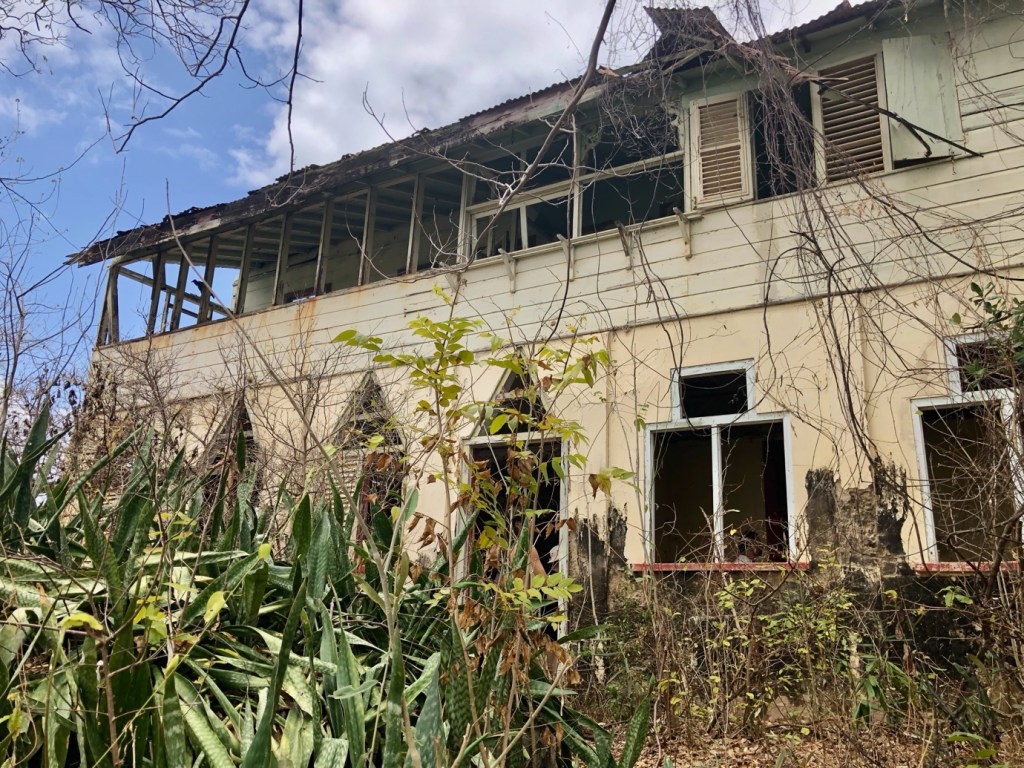
One of the deserted dormitories on Chacachacare (April 2024).
 Gillian Ramchand